Showing posts with label reading. Show all posts

Sunday, October 9, 2011

Learning About Characters

We have been learning about characters.  A character is a person, animal or object come to life in a movie or book.

We have used several different methods to extend our learning:
  • character webs: all the things we know about the character
  • venn diagrams: comparing similarities and difference between characters
  •  predictions: predicting character actions
  • & thinking about why we like certain characters.
Below, we wrote about our favorite character in the book, The Falling Leaves by Steve Metzger.


What I liked about my favorite yellow leaf was when the wind blew the leaf away.


I am drawing Red Oak.  He falls in the mud.


Purple Beech
I am Purple Beech because I like mud.

Sunday, September 25, 2011

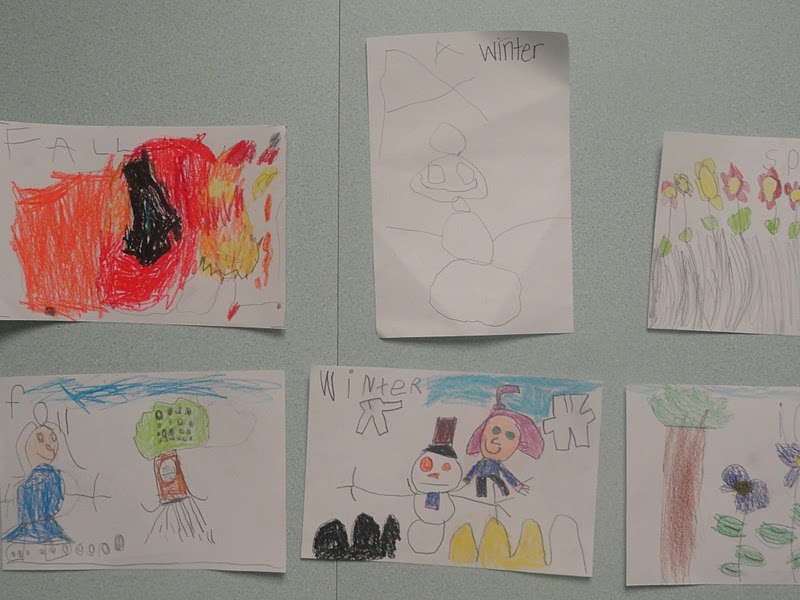
Fall Poems

Poems are such a wonderful way to introduce the children to mental imaging.

Say... Mental imaging is when you mind makes a picture of what your reading.  It is full of colors, smells, sounds.  Anything your senses can imagine.  Today we are going to read a poem and create mental images in our minds. 

Remember to think about the colors, smells, and sounds as well as the picture your mind creates. 

There is NO talking during this activity.  Everyone will have a slightly different mental image and this is perfectly okay.

Start by having the children close their eyes and read the poem through several times.  After you have read the poems though, pass out the poem or a sheet of white paper. 

Read the poem through again several more times.  This time have the children use pencils and crayons to illustrate the mental image their minds are creating. 

During this time, I walk around to encourage silence and detailed drawings.  I might question a child by saying something like... What color were the leaves in the poem?  What was happening to the leaves?

After the children have completed their drawings, we come to the floor with our drawing in hand.  The children think-pair-share with a partner about their mental images.  Then, I allow the children to share out some of their noticings.

After the children share out, I might take the time to question a child on something I noticed as I walked around or allow a child to explain something he/she drew to the rest of the class.

This simple activity quickly becomes a favorite and can be done numerous times through out the year.  I try to do this activity with a poem at least once a week.

Crunchy Leaves

Autumn Leaves

Raining Leaves

Leaves Are Floating Down

Autumn...

Lately, we have delved into a study of fall.  In Texas, we do not get to cherish the true beauty of this season.  We have to do alot of reading and researching to view the changing of the seasons  in all their glory.

Below you will find some of my favorite fall activities:

1.  The seasons make a pattern: fall, winter, spring, summer.

Each kiddo selects a season and draws a picture.  Then, we take all of our pictures and create a pattern of the seasons. 


2. Comparing summer and fall. 
Below is a chart the class and I made together.  Sometimes, I do a venn diagram instead.

3.  Seasonal Trees
We made summer trees with lots of green leaves.  The children had to unscramble the letters in the word summer and place the letters side by side to make a word.

This was 2 lessons:
1.  what a summer tree looks like
2.  a word is a group of letters with no spaces between them.

We will create a tree for each season by the end of the year.  I will post our fall trees soon.

4.  The children wrote a goodbye to summer listing the activity they had the most fun doing.
We brainstormed tons of summertime activities before beginning the writing activity below.  The children had to share what they were going to write with a partner in a think-pair-share before beginning.  Then, the children had to prewrite by drawing an illustration of the activity in full color.  Finally, the children had to sound out their words and try to record a beginning and ending sound for each word in the sentence.


I will post the fall equivalent soon... Hello, Fall! I will have fun__.

5. We learned several things about fall and charted our learning:
  • different activities
  • kind of clothing worn
  • how the weather should change
  • & other characteristics the children may not have already known.

Books to Consider for Your Lessons:

Click directly on the book to take you to its amazon page.
Fall (First Step Nonfiction)
How Do You Know It's Fall? (Rookie Read-About Science)
When Autumn Comes

Here are documents I used for my lessons:

Goodbye, Summer! Hello, Fall!  ... for some reason google docs is not recreating the document exactly right.  There should be no space after the "I will have fun" on the second section.  If you know what I am doing incorrectly, please let me know.

Summer Word for Summer Tree... Not saving as a PDF.  How can I do this?  It is changing all my fonts.  Think that might be my orginal problem as well.

Fall Word for Fall Tree

Wednesday, September 21, 2011

Owl Babies by Martin Waddell

Ahhhh, Fall.
The weather is perfect and the world is full of all my favorite colors.  What could be better?

Well, the perfect read aloud, of course.
Owl Babies by: Martin Waddell is the perfect book for going over parts of a story.  I draw a four square on chart paper.  We flip through the story and make predictions on the characters, setting, problem, and solution. 

In the first box, I draw a simple smiley face.  This is where we list the characters.

In the second box, I draw a tree and house.  Here we write all the places we noticed the characters where from our preview.

In the third box, I draw a broken heart.  This is where we record the problem.

The last box has a heart drawn in the corner for solution.  We write about how we think the problem will be solved by the characters in the story.

At this point, I ask if there are any questions about the story.  I will remind the children of their questions as we are reading.

I read the story through.  After the story, we go back to our chart and make changes as needed.  We cross through incorrect information and add in the information we have learned.  We talk about how important it is to make predictions about what we are going to read in order to focus our thinking about the story.

Additional Activities:
  • create your favorite character
  • create a web about each of the owl babies
  • use the webs to discuss the similarities and differences   between the characters
  • stop before the end of the story and make predictions... use construction paper to make a collage of the prediction
  • draw a picture of your favorite part
  • draw your favorite character in your journal and write a sentence about why you like that character
  • text-to-text connection... think about a time you were scared like Bill... think about a time your mom or dad left you at home and went somewhere else.
This story is simple and endearing.  I am sure each of you will come up with wonderful ways to use this story in your own classrooms.  Feel free to share your ideas in the comments.  I am always looking for new ideas.

Sunday, September 18, 2011

Learning About Characters

Characters are the people or animals in the story.  Sometimes a character is an inanimate object that has come to life such as a talking car or stuffed animals, etc.

Characters are the heart of the story.  Characters keep you coming back to read the story time and time again.

This week our focus was two fold:

*what do we know about the main character 


* & what are the character's actions and why did the character do what he did.


We have used several different stories in the past few days to learn about characters.  Below you will find a few of my favorites:

Max Lucado

Kevin Henkes

Rosemary Wells

Mary Whitcomb

Patty Lovell

In the photos above, you will see my two favorite ways to chart our responses: character web and a simple T chart.

What are some of the ways you teach characters to the little guys?

What graphic organizers do you find easiest for kinder kiddos to understand? 

Thursday, October 21, 2010

Seeds, Seeds, Seeds

March and April are the perfect time of year to begin planting a small garden with your child. Consider using a window planter if your space is limited.


Before beginning, read the book Seeds, Seeds, Seeds. In this book, Buddy receives a package from Gramps that has a weeks worth of fun activities all relating to seed exploration. Each day Buddy pulls out a small bag and opens it to find an exciting new project for the day.

To really bring this book alive, have an aunt, uncle, grandparent, etc send your child a weeks worth of seed activities. You could have the book included in the package or read the book prior to the arrival of the package.

(Reading the book prior to the arrival of the package will build your child's schema or background knowledge for the activities. They will more than likely relate back to the book and can use the book as a resource when completing the activities.)

After completing all the activities, draw a picture or allow your child to dictate favorite activities or memories revolving around all the fun you both have shared. You may even want to send a similar package to a good friend or niece/nephew. Have your child help to select the activities and put the package together.

Have fun exploring and learning about seeds with Buddy.

*Check out other titles by Nancy Elizabeth Wallace at your local library. All of her books are fantastic!*

Muncha, Muncha, Muncha

This is one of my favorite books when I am studying plants. In this story, Mr. McGreely wants to have a vegetable garden. He finally decides to plant one, but there is a big problem. Three little bunnies keep eating his veggies. Read this beautifully illustrated book to find out how Mr. McGreely tries to keep the bunnies from his veggies.


Activities to Consider:

1. Compare Muncha, Muncha, Muncha with The Story of Peter Rabbit. How are these two stories the same? different?

2. Start a story journal. Get a composition notebook (much sturdier for little hands). Write your child's name on the front cover. Have your child record different things in the journal after hearing a story.

* Draw a picture of your favorite part.

* Stop before finishing the story and draw a picture of what you think will happen. ETC.

3. Draw various vegetable/fruit shapes on the cardboard from a box of cereal. Cut out the shapes. Have your child trace and cut out the various fruits and veggies.

*Hang these from a wire coat hanger with yarn to make a mobile.

*Fold copy paper in 1/2 and glue one veggie/fruit on each page. Label the food. Allow your child to practice pointing to the words and reading them.

4. Have your child color a picture of a vegetable garden with crayons. After the picture is complete, you can have your child use green watercolors to paint over the entire picture.

5. Plant a small vegetable garden in your backyard.

6. Cut up various fruits and vegetables into bite sized pieces. Give your child bamboo skewers. Have your child pattern fruit onto the skewer. Eat as a healthy snack.


The Perfect Nest

I just got this book in my last Scholastic book order and LOVE it! We are doing a unit on birds in my kindergarten class. This book was "perfect".

The pretense of this story is that Jack the cat wants to build a nest to attract a chicken. Jack hopes this chicken will lay a yummy egg that he can cook it into an omelet. Throughout the story, various birds arrive at the nest. You will meet birds of all kind. This book is so much fun to read because each bird has a different accent. I promise you will get a giggle out of your little ones.

Activity Suggestions:

1. COOKING: Make cheese omelets or scramble eggs with your kiddo. Have your child count the eggs as they are cracking them into the pan.

2. NEST MAKING: Collect various items from nature and try to make your own perfect nest. Leave the nest in a tree in your backyard and see if a bird makes it her home.

3. FEATHER PATTERNS: Pattern colored feathers on a sentence strip/headband and staple into a hat. write the counting numerals under each feather.

4. FEATHER PAINTING: Use the tip of a feather as a paint brush and create a beautiful piece of painted art. For a more 3D effect, glue some of the feathers onto your painting.

5. FEATHER COLLECTION: Begin a feather collection. Tape feathers into your nature journal as you find them and record what kind of bird they come from.

6. EGG EXPERIMENT: We conducted an experiment to see the likelihood of an egg surviving the fall from a bird nest. Each child brought in an egg that had been packaged in various ways hoping to keep the egg from cracking. I crawled on top of a ladder and dropped each "nest" (the packaged egg) from the top of the ladder. We noticed that most of the time if the package landed on its bottom the egg survived/ didn't crack.

I dropped an egg and had it land on its bottom. Then, I dropped an egg and had it land on its side. The first egg did not break and the second egg did. We discussed the importance of the egg's bottom and top being the strongest so that when it is laid by the hen it can survive the fall.

7. EGG MARBLE PAINTING:Draw a simple egg shape on the cardboard from a cereal box. Cut it out and use it as a tracer. Have your child trace and cut out the egg on white paper. Choose 3 colors f paint. Using three different marbles, dip one into each color of paint. Place your child's cut out egg into the bottom of a disposable pan. lay the marbles on top of the paper. allow your child to roll the pan slowly in all directions. This should apply a random design of color on the egg.

8. EGG CRAYON RESIST: Follow the direction above. EXCEPT instead of marble painting... Have your child design his/her "perfect" egg using crayons. After the egg has been colored, use watercolor paint to paint the entire surface of the egg including the crayon. The crayon will resist accepting the watercolor creating a quite stunning effect.

Have more ideas for the perfect nest. Please leave your ideas in a comment. Thanks a bunch!

Butterfly Book Pair

I love to pair a nonfiction and fiction book together for book studies and exploration with kids. When children begin to learn real life facts about their world, I have found the level of engagement to sky rocket.


**************************************************************

The two books I have chosen today are perfect together.

Who doesn't love Eric Carle's The Very Hungry Caterpillar?


If the beautiful illustrations don't instantly catch your eye, then the simplicity of the text surely must. I think kids can relate to the concept of eating maybe a little more than they should have and the pattern of the days of the week are predictable. Older children will begin to guess which day is coming next before the page is even turned. The suspenseful waiting to see if you are correct is enough to keep the children engaged until the last line of text is read.

*************************************************************

Are You a Butterfly is a wonderful twist on nonfiction. The life cycle is presented in a fun conversational tone. (Just an Example- not actual text: Are you a butterfly? If your mother lays an egg on a leaf, then you definitely could be a butterfly.) The conclusion of the book and all books in this series always ends with ... If you look like this or this or this, then you are a human child.

I absolutely adore both of these books.

*****************************************************************

The Hungry Caterpillar by Eric Carle


Suggested Activities

1.Retelling Using a Felt Board or Puppets: DLTK

2.Sequence the Story: DLTK- Place the picture cards in order and tell what happened in the story.

3.Retelling Hat: To turn the retelling pictures into a hat, staple several strips of 3-4" wide construction paper together. Measure your child's head to ensure it will fit. Lay the long strip flat and allow your child to glue the pictures in order onto the strip. Allow glue to dry and staple the strip to fit your child's head. Children absolutely love to wear these.

4.Caterpillar Kabobs: Cut small chunks of the various foods that were in the story. Have your child push them onto a bamboo skewer in the correct order. Be sure that the child counts out the correct number of each food item.

*******************************************************************************

Are You A Butterfly? by Judy Allen and Tudor Humphries

1.Random Butterfly Craft Ideas: DLTK

2.Random Caterpillar Craft Ideas: DLTK

3.Colorful Name Caterpillars: Cut several circles out of construction paper. Have your child use a black marker to draw a face onto one of the circles. Glue pipe cleaners or skinny rectangles of construction paper to the "head" of the caterpillar as antenna. Have your child write one letter of his or her name on each circle. Use a pencil and have your child trace the letters with a marker if needed. After each letter has been written, allow your child to practice assembling the letters in order to spell his/her name. You can either place the circles in a baggie for your child to use again. OR Have your child glue the circles in order over lapping slightly to have a caterpillar friend to play with.

4.Caterpillar Counting: Follow the above directions except put numbers on the circles. Depending on the age of the child you could even consider skip counting.


My Beliefs on Teaching Young Children to Read

It took me a long time to develop some sort of personal beliefs on teaching reading (letters and sounds is a big part of it) to young children. I began my first year with letter of the week, but felt stifled by the structure and slow pace.

What if a child really doesn't need to go that slow?

The next year I changed to a flashcard method of drill and kill. Every day we would go through a set of alphabet flashcards and say the name, the sounds and make a motion to help us remember the sound.

This really helped the kiddos learn to read much faster and the kinesthetic (motion) approached helped those that struggled to remember the sounds of the letter. You could simply make the motion and they would recall the sound. I must admit I did this for many years.

A few years down the road, I began to feel like the above approach separated learning letter names and sounds apart from authentic reading and writing. I wanted children to understand that we need to learn the letter names and sounds because we want to be readers and writers. Letters and sounds are what makes up the message written on a page that someone wrote and someone else will read. I struggled with how to incorporate teaching letters and sounds through reading and writing for some time. I still do not have it perfected by any means, but here is a run down of some of the things that I do. I read a book to the children.

The book needs to have...


•large enough print that the children can distinguish each individual letter

•a simple picture representing the words in visual form

•and some sort of lesson that can be taught from the story (example rhyming pairs, a specific sight word to be recognized, etc.).

First, we read the book and discuss what the story is about: who is in the story, where does it take place, what happened, etc. We look at the pictures and make observations. We discuss things we know and things we want to know. What is our favorite part and why.

Then, we reread the story with a focus. In this case, letters and sounds. I always start my letter and sound study with the most important word the child knows... his/her name. I have each child focus only on the letters in their own name.

We hunt for letters that we know and circle them or highlight them. There is some really cool highlighting tape at teacher stores that you place on top of the letter or word and it can be removed a used a couple more times. it does not damage your book. You can also use Wiki sticks. They are stings covered in a wax coating. You can find them at most craft stores. Cut the Wiki stick to the length you want and use it to underline or circle by pressing it gently to the page. Remove when you are done and reuse.

When we find a letter we know or recognize, we name the letter, make the sounds, and make a motion to represent this sound. This motion could be as simple as using American Sign Language for that particular letter. We continue to do this for the entire book. The kiddos get really excited when they realize that the letters in their name can be found in other words.

Finally, we write a sentence or a 3 page book using the letters we found in the book. I try to follow the same pattern as in the story. For example, I can see a bird. The b could be the letter that begins the child's name. We will circle the b or highlight it with a yellow crayon. We say the letter name and sound and make the motion. I have the child write 5 really good Bs on the back of the page as well as illustrate the sentence with a picture that matches the words.  In this case, the child will draw a bird.

I place the book in a book that the child made in a "book box." A book box anything that can store books that your child can read. The easiest examples are laundry boxes covered in contact paper, large gallon sized baggie, or a plastic shoe box. If the child is working on writing just one sentence and illustrating it, I place these in a binder or folder. Sometimes I actually use a composition notebook to create these sentence stories in and when the time is write it becomes a personal writing journal as well.

Anytime you can read or write something authentic with a child he/she will have more buy in. Think about ready and looking at your grocery list together, reading labels in the pantry and hunting for the letters in your child's name and circling them while stating the letter name and sound. When your child draws a picture, label the items with a beginning sound in your child's favorite color. Write the rest of the letters in black. Point out the name and sound of the initial letter as you write it. Before you know it, your child will find letters he/she knows all around them.

I do have to say that I also teach my children to write their names correctly... capital letter and then all lowercase. I focus on lowercase letters because these are the letters that the children will read and write the most often. You would be amazed at how many children come in knowing the uppercase letters but have very little alphabetic knowledge about the lowercase letters. It is so important for the children to pick up the letter names and sounds for both the upper and lowercase letters as quickly as possible.

Here in Texas the children are required to write an entire page by the end of kindergarten. Most can do this by January with little assistance. Of course, words are spelled phonetically, sometimes spacing is off, and punctuation is sporadic. But it is usually readable.

For those that do not come in with the letter and sound knowledge, they can write 3-5 sentence pretty well by the end of their kindergarten year. The parents are always amazed by this huge accomplishment. I am not... Children are sponges that desire to learn as much as possible each and every day. They just need authentic activities that engage them at a high level and most of all they need to have FUN. The more games they can play the better. When reading and writing is an intrical and natural part of the day, children will naturally gravitate towards activities that focus on these activities.

My kindergarten kiddos can sit down and "read" (reading is different for every child... if someone looks at the pictures and tells a story that is beginning reading at its most basis form) for 15 minutes at a time usually after the first month of school. You always have those that can't sit that long yet, but most can if they are engaged and having fun. I guess that's it.

I know I have said alot, but I hope it allowed you to see a glimpse into a kindergarten classroom.

Expectations nowadays are no longer as basic as those in the past. Not that I agree with them all, but I do my best to incorporate my beliefs into what is mandated. It appears that todays children are up for the challenge.

Wednesday, October 20, 2010

Chicka, Chicka Boom, Boom

Chicka Chicka Boom Boom is a favorite among children and adults alike. It is a wonderful introduction the alphabet in a sing song rhyming format. Children almost sing the refrain right along with the reader... Chicka chicka boom boom will there be enough room for all the letters in the coconut tree?

Activities For Before, During, and After Reading:

before reading...

1. Look at the cover. make predictions about what the book will be about.

2. Flip through the book and talk about each page.

3. Locate various letters through out the book. Choose to hunt by name or sound depending on the skill level of your kiddo.


during reading...

1. Point to each letter as the letter name is read.

2. Stop periodically and inquire about the rhyming words.

3. Encourage your child to chime in and "read" the parts he/she can. This will be from memory at this stage, but that is perfect.


after reading...

1. Color a coconut tree. instead of having all the letters going up the tree, have your child cut out the letters to his/her name and glue them in the correct order under the tree or going down the trunk.

2. Color a tree and have your child cut a specified number of brown circles and glue them onto the tree. (Be sure to review the shape of a circle and talk about it having a curved face and no sides.)

Write a simple sentence below the tree... I have __ coconuts in my tree. Have your child copy of write the numeral in the blank.

Use this page to practice beginning reading. Read the sentence to your child several times pointing at each word as it is read.

When you feel your child is ready, have him/her point to the words and read them to you. Again, do this from memory is a-ok. The more the sentence is read from memory the more likelihood of the words being recognized in another context.

3. Write the above sentence or a similar sentence on a strip of paper. Follow the same reading format as in the above activity.

Once your child can point to the words and "read" them fairly independent count the words as they are read aloud. Practice counting the number of letters in specific words. Have your child cut the sentence into individual words (with your help). Now your child can reassemble the sentence and reread it.

Have your child pick up specified words and then place the word back in the correct location in the sentence.

4. Create a CONCENTRATION game. Choose between 6-10 letters your child needs to recognize and create cards for each letter. You will need to make two sets of the cards.

For example, you will need two As, two Ms, etc. Lay all the cards face down on the playing surface. Have your child flip over 2 cards and name each letter. If the letters match, your child keeps the pair. If not, the cards are flipped back over and play continues. The winner is the player with the most matches at the end of the game.

Ways to Play Concentration:

* match uppercase letters to uppercase letters

* match uppercase letters to lowercase letters

* match a letter with a cut out picture that starts with that letter sound... example: F matches with a face

* name the sound when the card is flipped over instead of the name of the letter

* name a word that begins with that sound when the card is flipped over

5. I have create a letter and sound game for download. It is perfect for alphabet practice.

6. Magnetic letters are fun to sort and begin to spell some basic sight words. Sort the letters by color, size, capital and lowercase, letters or numbers, sticks letters and curve letters, letters that hang below the line and letters that do not, etc.

Write a few words your child would like to know on index cards. For example... mom, dad, cat, dog, like. Have your child make the words out of magnet letters. Discuss the difference between a letter and a word. If the letters on in the correct order... c a t, this is not a word. The letters have to much space between them. These are simply just letters. For the letters placed in this order to be a word, the must be little to know space between each letter... cat.

Note: You can use metal cookie sheets or stove top burner covers as a surface to build words on or to create sorts. If you are going to use the cookie sheet for sorting, painters tape is great. you can tape off the cookie sheet into however many sections you want. The child can place the letters into the various spaces depending on what characteristics the letters have.

I almost forgot. Magnetic letters can also be placed in ABC order. OR... you can name a letter or sound and have your child find that letter. If he/she gets it correct the letter goes in a pile in front of the child. If not, the letter goes in a pile in front of you. Your child wins if he/she gets more letters than mommy.

7. Watch the story come to life with the following You Tube video. Chicka Chicka Boom Boom You Tube Video


The Kissing Hand by Audrey Penn

[kishand2.gif]

The Kissing Hand by Audrey Penn is one of my favorite books to start the year. A little raccoon named Chester is going to school for the first time and he is afraid to leave his mommy. Chester's mommy kisses the center of his hand and tells him when he misses her to touch his hand to his cheek and her love will flow into his heart. At the end of the story, Chester gives his mommy a much needed kissing hand that she uses as soon as he scampers off to school.


Possible Activities:

•Homework: In my meet the teacher packet, I provide each child with a piece of construction paper and directions for making their own kissing hand. Mom/Dad traces his/her hand and cuts it out. Then, Mom/Dad needs to decorate the hand any way she/he chooses.

When I made T Man's kissing hand, I covered the entire hand with photos of the family. No part of the construction paper was visible. T Man loved his hand.

Anyways... During the first week of school, the children take turns sharing their kissing hands with the class. I hang the hands in the hallway next to our classroom door. If a kiddo needs a little reminder of home, he/she can easily just go outside the room and look at the hand. It always works to bring a smile to the child's face.


•Chester Raccoon: The main character of the story, Chester, quickly becomes a favorite with all children. They know they are not alone in their feelings on the first day of school. Years ago I found this super, cute way to make Chester that is easy enough for the beginning of the kindergarten year. It does take a bit of prep on the part of the teacher, but well worth it in the end.

What You'll Need For Each Child:

3 x 6 brown rectangle

3 x 4 black rectangle

3 x 4 brown rectangle

small black triangle

1 x 2 black rectangles

small brown triangles

3 x 3 white squares

Just assemble the pieces to look like the above picture. The site this activity was originally found at is listed in my links at the bottom of the post.

Great Links for the Kissing Hand:

virtual vine

little giraffees