Showing posts with label science. Show all posts

Friday, November 18, 2011

What is Science?

At the beginning of kindergarten, we do a unit on science safety.  The unit includes:
  • What is science?
  • What is a scientist?
  • What do scientist do?
  • plus tons of hands on exploration.
On the very first day, I always begin by charting what the children think science is.  The answers vary greatly and provide me with some valuable information on where we need to head with the unit.


After we brainstorm what science is, the children draw pictures in their journals based on our conversation.  Each picture is outlines in felt tipped pen and colored.  We label the pictures with at least beginning sounds, but hopefully more.

The very next day, we review what science is and I pose another question... What is a scientist?  Again, we chart our responses and the children draw a picture of themselves being their favorite kind of scientist.  I encourage the children to add detail in the picture such as a tool the scientist might use.

The children dictate a sentence about what they are studying and I record it on their journals.


On the days following this introduction, we work on completing a booklet that explains many aspects of being a scientist.


The first page is an overview of what we will learn.  It provides the children with factual information and a repetitive text that they will be able to read over and over again.

We begin by reading through the above text.  The children highlight the sight word can.  We practice the word in a vary of ways... writing with crayon on the table, tapping the letters as we orally spell the word, magnetic letters, etc.

TIP: Tennis balls erase crayon from most school tables.

Then, we reread for meaning.  We discuss what each sentence might mean and make some predictions.  This would be a great time to create a chart with the class predictions.

Finally, we draw a picture of ourselves wearing goggles.  We discuss that science must experiment and learn in a safe environment and wear goggles is one way to do this.


The second page is about asking questions.  We discuss what a question is and what kind of words begin a questions.  We make a list of questions that a scientist might ask.  Finally, we think about one thing we would really like to know about.  I write each child's question at the top of the page and the child draws a picture to match the words.

I usually take this opportunity to go over the fact that when we write our pictures and words will match each other.


The third page is about how scientist explore.  We usually create a bubble map with tools scientist use to explore.  Then, the children choose a tool and something they could notice using the tool.  I record what the noticed while exploring.  The child will draw a picture of the tool and what they noticed.


The fourth page is about how scientist measure.  We discuss what it means to measure and create a list of various tools you can use to measure.  Some of these tools might have been included in the previous chart as well. 

The children draw a picture of three measuring tools and write a label for each.

**I am not sure if you noticed in the pictures, but I have the children create a pattern out of the letters that make the sentence on each page.  This allows me to assess patterning at the same time as getting in science standards.**

Sunday, October 9, 2011

Properties of Objects


A properties tells how something looks, sounds, taste, feels, or smells.

The children loved helping me fill in the missing sounds from our properties of objects chart. After filling in the chart and explaining each property, we began sorting. 

Below are the sorting mats we used.


Below is the 4 square chart we completed at the end of the unit.


A Leafy Science Experiment

What will happen when you add water to a leaf that has been colored red and yellow?

Why, you get orange of course.


Directions:
  1. Die cut leaves out of coffee filters.  If your school does not have a die cut machine, simply cut with scissors.
  2. Have your children color the leaf with red and yellow marker.
  3. Next, they will use a water dropper to cover the leaf with water.
  4. Finally, bring the group back together to discuss your findings.

Properties of Leaves

The kiddos loved going on a leaf walk to collect tons of fallen leaves.  After we returned to class, we discussed which properties of leaves we would like to write about.  The class decided to record the color, shape and size of their leaves.

We copied the sight words IT and IS.  The rest of the sentence was sounded out and spelled phonetically.  The entire class did a fantastic job.


It is green.
It is big.
It is shaped like a heart.
 
It is brown.
It is big.
It is smooth.
 
It is brown.
It is small.
It is hand shaped.

Sunday, September 25, 2011

Autumn...

Lately, we have delved into a study of fall.  In Texas, we do not get to cherish the true beauty of this season.  We have to do alot of reading and researching to view the changing of the seasons  in all their glory.

Below you will find some of my favorite fall activities:

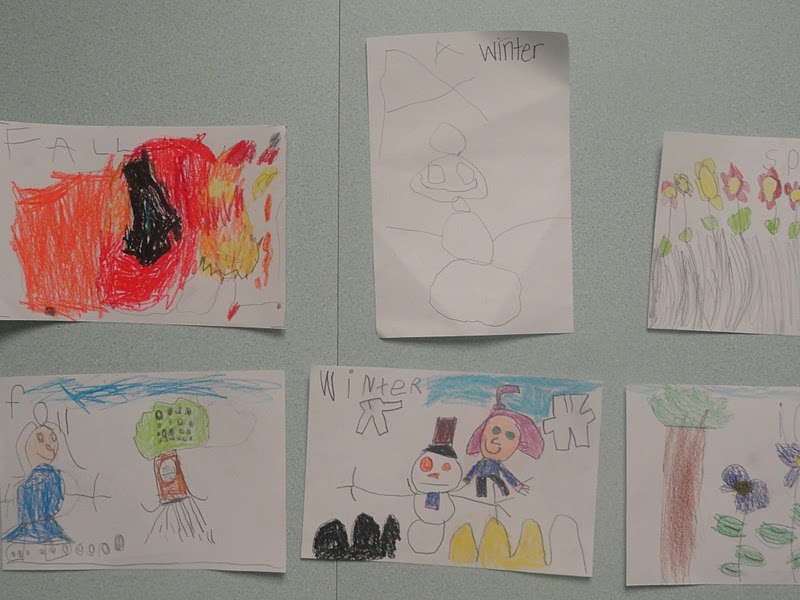
1.  The seasons make a pattern: fall, winter, spring, summer.

Each kiddo selects a season and draws a picture.  Then, we take all of our pictures and create a pattern of the seasons. 


2. Comparing summer and fall. 
Below is a chart the class and I made together.  Sometimes, I do a venn diagram instead.

3.  Seasonal Trees
We made summer trees with lots of green leaves.  The children had to unscramble the letters in the word summer and place the letters side by side to make a word.

This was 2 lessons:
1.  what a summer tree looks like
2.  a word is a group of letters with no spaces between them.

We will create a tree for each season by the end of the year.  I will post our fall trees soon.

4.  The children wrote a goodbye to summer listing the activity they had the most fun doing.
We brainstormed tons of summertime activities before beginning the writing activity below.  The children had to share what they were going to write with a partner in a think-pair-share before beginning.  Then, the children had to prewrite by drawing an illustration of the activity in full color.  Finally, the children had to sound out their words and try to record a beginning and ending sound for each word in the sentence.


I will post the fall equivalent soon... Hello, Fall! I will have fun__.

5. We learned several things about fall and charted our learning:
  • different activities
  • kind of clothing worn
  • how the weather should change
  • & other characteristics the children may not have already known.

Books to Consider for Your Lessons:

Click directly on the book to take you to its amazon page.
Fall (First Step Nonfiction)
How Do You Know It's Fall? (Rookie Read-About Science)
When Autumn Comes

Here are documents I used for my lessons:

Goodbye, Summer! Hello, Fall!  ... for some reason google docs is not recreating the document exactly right.  There should be no space after the "I will have fun" on the second section.  If you know what I am doing incorrectly, please let me know.

Summer Word for Summer Tree... Not saving as a PDF.  How can I do this?  It is changing all my fonts.  Think that might be my orginal problem as well.

Fall Word for Fall Tree

Tuesday, July 12, 2011

Creating A Research Booklet

Creating a research booklet the children can use to record their findings seems like a daunting task.  I'm not going to lie and say it is easy, but it is definitely doable if you are willing to put in the time.
 
I use WORD to make my research booklets. The first thing I do is decide if I think my kiddos need a full size booklet or if they are capable of using a 1/2 size booklet. My main concern is... Are most the kiddos capable of writing on smaller lines.  If the answer is yes, go with the 1/2 size.  If not, go with the full size booklet instead.  Once that has been decided I can begin creating the booklet.
 
I am going to explain how I create a 1/2 page booklet.

Start by setting the page orientation to landscape. Then, make a large text box on 1/2 of the page. Copy this text box and move it to the remaining half of the page. Move the text boxes as close to the edge as possible and make sure to leave enough room between the text boxes to cut the pages in 1/2.  Always click on print preview to see if the entire text box is visible.  If not, you will need to move the boxes around accordingly.

This will be the template you will use to create the entire booklet.  So, go ahead and select a font and save this page as template.

Now, to begin.
For the front cover, you will need to
  • leave blank lines for the title
  • by: and a blank line for the children to record their names
  • and a space for a picture or illustration.  
If you opt to use a picture, you can insert the picture at this time between the title lines and the name line. OR You can locate several pictures and download them to another document. When the class is creating the cover page, print and lay out the picture options. The children select the one they want and glue it into the space provided. 

When the front cover is complete, right click on the text box. Select borders and shading. Opt for no color on the border. This will make your page appear as though you created everything directly on the page instead of using text boxes and manipulation. Now, save the document as 1front cover. Delete the content from the boxes once they are saved.
**HINT: I create one text box and copy the content and paste it into the other text box. This makes the process go by much more quickly.**

For the rest of the booklet, you will follow the same procedures as above for removing the border, saving, and deleting the content of the text box. When you save the pages, I always go with something simple (2contents, 3beak, 4legs, 5flying, etc.)  I include the numbers, so that my booklet is saved in the correct sequence.

Makes it super easy when it comes time to print. The booklet will print in order. You can just lay it on a copy machine and choose double staples. Then, you will cut the booklet down the middle and add more staples if needed. No need to sort, staple each booklet individually or any of that mess. 

Anyways...  
When you begin the next page in the booklet, go back and make the border on the text box visible again. This makes it easy to manipulate when you begin to add other features onto the page.

For each of the remaining pages in your booklet you will have to know the non-fiction feature to be showcased on that page. I always start by drawing lines on the page using the shift and line button. The line button is located next to the zero on the keyboard. You will have to play around with the spacing by changing the font size and hitting enter at the end of the line.

This can be a bit frustrating, but it gets easier with practice.  At this point, save this as template2.
Once you have the lines spaced as you wish it is time to add the features you want to include. Below you will find suggestions on how to include various features on your document:
  • contents:  Write the words... Table of Contents on the top of the page.  Leave enough lines for each of the pages you will include.  You will have the children fill out the title of the section and the page numbers as they complete that page of the booklet.
  • title and headings: Bold face the lines, so the children know where to write this information. Shorten the length of the lines as well, so that it stands out from the rest of the print. If appropriate, center the line in the text box to even further distinguish it.
  • photos: Add an additional text box at the top or bottom of the page. Make sure the text box is covering all of the lines on that particular section. OR Make the text box small enough that you can still write next to it.
  • close ups: Go to the symbols section of your drawing tool bar. Click on the circle icon. Draw the circle the desired size you want and move it into place on the document.  Here you will have the choice of playing around with the lines and deleting and tabbing the line over until they are not visibly sticking out of the wrong side of the circle. OR you can leave it and white out the lines after you print.
  • captions: Create a photo box or close up circle. Leave lines under or beside the feature. This will give the children a place to write the caption. Add an extra line or two of space after the caption to separate it from the remaining text.
  • labels: Insert a picture that requires labeling.  Go to symbols on the drawing tool bar and select the arrow.  Draw arrows in the appropriate size pointing to the various parts to be labels.  Inside a small text box draw a line.  Right click on the text box and select borders and shading.  Select no color for the border.  Copy the text box and paste it into the various locations next to the arrows, so that the children may label the appropriate items.  OR You can have the children create an illustration and glue it onto the page and label it independently.
  • list: If you want the class to work on list writing (for example, listing the type of food a hummingbird eats), bullet the lines of print on that particular page. If you know the books you have available list 3 different foods, bullet 3 lines.
There are many other non-fiction features, but this is a good place to start.  Once you have completed all you pages using variations of the examples above print the booklet.  Copy 1/2 the amount of booklets as you have students.  Cut the booklets in half and add additional staples if needed.

Pass out the booklets each day after you lesson.  Have the children complete that particular section of the booklet.  Don't forget to write page numbers on the bottoms of the pages and record the information on the table of contents.

Collect the booklets as the children finish.

I like to include items that the children make in place of some of the xeroxed pages.  Below are a few example:
  • construction paper animals, plant, model of the sky, etc.
  • paintings
  • diagrams made from construction paper and glued into the booklet.
  • construction paper or illustrated drawings of various things (example, foods birds eat... create a worm, seeds, grass, etc.)
  • crayon resist on some of the illustration included in the booklet.
If you have any other ideas on how to do research with young children, please let me know.  I love to get new ideas and incorporate them with my own.

Research With Five Year Olds

This is the first time I have completed in depth research with kindergarten children.  It has been a challenge, but well worth the effort.

How To Help Your Children Complete a Research Project:
*Complete a mini unit on Non-fiction Text Features Before Beginning.  The number of features included will depend upon the age of the children completing the research.*

Day One... selecting a topic
You and your children will need to brainstorm several topics to research.  Try to be a bit specific.  This will help when gathering information.  For example: Learning about bird beaks is very broad and overwhelming.  But... Learning about the beak of a hummingbird is a much more specific goal and more readily achievable.

Day Two- Four ish... gathering materials and noticing
Take your little ones to the library try to find books and magazines about your topic.  You will want to choose the topic that has the most materials available for you to use. 

Don't forget to check out the fiction section as well.  There are terrific fictional stories nowadays that contain just as much factual information as the non-fiction counter part.

Once you have selected the books and checked them out.  Leave the books in a well visited area for several days.  Remind your children to look through the books and draw a picture or write words (on cut up pieces of paper) about the things they are noticing.  Sticking with the hummingbird theme... Your child might draw a long, slender beak sucking nectar from a flower.  OR  Your child might write the words 'Hummingbirds drink something out of flowers.  What is it called?'

Always encourage wonder and questioning.  This helps tremendously when you get to creating an outline of the research.

Day 5... fiction versus nonfiction
Gather all of the books into a large pile.  Explain the difference between fiction and nonfiction books.

A fiction book tells a story.  It has pictures that have been drawn or created. The story can have some factual information, but you are primarily reading the book for fun. 

A nonfiction book has facts (things that are true).  It has a table of contents, photographs, captions, diagrams, maps, and much, much more.  Most of the time a nonfiction book will contain only facts, though, there are times that a particular story is an important part of the information needed for that specific book.  Nonfiction books are read primarily because you are wanting to learn something.

After explaining the difference between these two genres, allow the children to look through the books and decide which should be placed in the fiction pile and which should be placed in the non-fiction pile.

Once the sort is completed be sure to keep the two piles separated.  You may even want to keep the fiction books in a hidden location and bring them out to read to your children as you see fit.

Day Six... wonderings and questions
Pass out the non-fiction books on the subject you are researching.  Give the children about 5-10 minutes to look through the books.  Each group of children should have at last 5 post-it notes to place on the pages they have a wondering.

After the time is up, have the children bring their books and come to circle spot.  Allow children to ask their questions using specific pages from the text.  Record the questions on a chart tablet.

Day Seven... selecting the content for your book and writing the content page
Display the chart tablet with the questions from the previous day.  Ask the children... "What kind of information did you notice you could find in the books we looked at yesterday?"  Pull out several books and read from the table of contents.

After the children have gone over the type of information available for their research, draw their attention to the question chart.  Explain that you are going to read the questions to them again.  If they think the question can be answered with one of the available resource, the child should place a thumbs up over his/her heart.  If not, place a thumbs down over the heart.

As you are going through the list, mark an X on all questions that the children did not feel they would be able to answer using the available resources.  If you notice anything that your would like included or something you feel might be hard to research, have the children explain their reasoning for the choice they mad eon that particular question.

Sometimes having a brief discussion can clarify for both you and the children.  At that point you will have to help them narrow down their research to a manageable few.

Day Eight... deciding on non-fiction features to be included in the book and creating an example of the first topic entry
Come prepared with the features of non-fiction you would prefer to include in your research booklet.  Have examples of the features mark in various sources to show to the class.

Show a specific feature and discuss how the author of the book used this feature to enhance learning.  Looking at the questions that you will explore have the class decide on which  question they feel would benefit from the use of that specific non-fiction feature.

Go through and do this for every feature you want to include.  Make sure each question has at least one feature to be used on that section of the booklet.  If all else fails, you can include a title or heading on that particular page.

For a detailed description on how to create a research booklet, check out my post titled: Creating a Research Booklet.

Day Nine- Ten... research topic 1 and 2 and record information
Before the lesson begins read the questions you will be addressing  during the lesson.  Give each child a piece of paper and pencil to draw or record the answers as they listen to you read.  Read from several different sources selecting the passages that pertain to the information you are seeking.

At some point during the lesson, refer to the table of contents and/or index to locate the information.  This will help children realize that they do not have to read a non-fiction book from front to back.  It is okay to skip around and locate what you are looking for.

At the end of the lesson, have children share out their findings.  Record comments on a chart tablet and look back into text to verify.  This will help you make sure information is accurate.

Day Eleven... show examples of ways to record findings and children completing topics 1 and 2 for book
Already have several examples of how to record findings in the research booklet.  Show the examples to the class and ask for questions.  Before you send them off to complete the appropriate sections go over the information learned form the previous day.

You may choose to help the class fill in the table of contents now or at the end of the project.  I found it to be easier to complete the table of contents at the end whole group.

Day 12- End... continue as above until entire content of the book has been covered and the children have completed their nonfiction research book

Thursday, October 21, 2010

Butterfly Book Pair

I love to pair a nonfiction and fiction book together for book studies and exploration with kids. When children begin to learn real life facts about their world, I have found the level of engagement to sky rocket.


**************************************************************

The two books I have chosen today are perfect together.

Who doesn't love Eric Carle's The Very Hungry Caterpillar?


If the beautiful illustrations don't instantly catch your eye, then the simplicity of the text surely must. I think kids can relate to the concept of eating maybe a little more than they should have and the pattern of the days of the week are predictable. Older children will begin to guess which day is coming next before the page is even turned. The suspenseful waiting to see if you are correct is enough to keep the children engaged until the last line of text is read.

*************************************************************

Are You a Butterfly is a wonderful twist on nonfiction. The life cycle is presented in a fun conversational tone. (Just an Example- not actual text: Are you a butterfly? If your mother lays an egg on a leaf, then you definitely could be a butterfly.) The conclusion of the book and all books in this series always ends with ... If you look like this or this or this, then you are a human child.

I absolutely adore both of these books.

*****************************************************************

The Hungry Caterpillar by Eric Carle


Suggested Activities

1.Retelling Using a Felt Board or Puppets: DLTK

2.Sequence the Story: DLTK- Place the picture cards in order and tell what happened in the story.

3.Retelling Hat: To turn the retelling pictures into a hat, staple several strips of 3-4" wide construction paper together. Measure your child's head to ensure it will fit. Lay the long strip flat and allow your child to glue the pictures in order onto the strip. Allow glue to dry and staple the strip to fit your child's head. Children absolutely love to wear these.

4.Caterpillar Kabobs: Cut small chunks of the various foods that were in the story. Have your child push them onto a bamboo skewer in the correct order. Be sure that the child counts out the correct number of each food item.

*******************************************************************************

Are You A Butterfly? by Judy Allen and Tudor Humphries

1.Random Butterfly Craft Ideas: DLTK

2.Random Caterpillar Craft Ideas: DLTK

3.Colorful Name Caterpillars: Cut several circles out of construction paper. Have your child use a black marker to draw a face onto one of the circles. Glue pipe cleaners or skinny rectangles of construction paper to the "head" of the caterpillar as antenna. Have your child write one letter of his or her name on each circle. Use a pencil and have your child trace the letters with a marker if needed. After each letter has been written, allow your child to practice assembling the letters in order to spell his/her name. You can either place the circles in a baggie for your child to use again. OR Have your child glue the circles in order over lapping slightly to have a caterpillar friend to play with.

4.Caterpillar Counting: Follow the above directions except put numbers on the circles. Depending on the age of the child you could even consider skip counting.


Butterfly Activities

I did two really fun activities with my kinder kiddos that I forgot to post. Better late than never is my motto. If not, I would probably start to wonder why I seem to keep always running behind.

Butterfly Life Cycle:
1. Fold a small piece of construction paper in half like a hot dog. Cut four even space slits in the top half of the paper. Cut until you reach the folds. This will make a flip flap book.

2. Label each flap with one of the stages of the butterfly life cycle: egg, caterpillar, chrysalis, butterfly.


3. Either pre-cut the pieces for your child if they are little or allow your child to cut out the pieces independently if you feel they are ready.

You will need the following:

•three green leaves

•one small teeny-tiny yellow circle for the egg

•one 1 inch piece of pipe cleaner bent to look like a caterpillar

•a piece of brown or green crumbled paper to make the chrysalis

•one green stem

•one colored flower cut from construction paper

•two squares of tissue paper.

4. Use the posted pictures as a guide for where everything goes and how it should look. To make the butterfly, lay the two pieces of tissue paper one on top of the other one. Then, twist the tissue paper gently in the middle. TA-DA! You have a simply, beautiful butterfly. Being a kindergarten teacher I always like to add a reading/writing component to my crafts. Older kids can begin to sound out the words for each sentence and record them under the appropriate flap.

For example: The butterfly lays an egg. a caterpillar hatches out of the egg. A beginning writer would probably record this: VBLUG AKHTVVG. That is perfect for a beginning writer. I have the children point to the words and read them back to me. I record the sentence correctly under the child's writing and have them practice reading correct writing while pointing to the words.

For a younger child, I would write the sentences and read them to the child while pointing to each word as it is read. I might have the child point to the words if appropriate. When ready your child will automatically, begin to take the lead and point and read the words to you.


Symmetrical Butterfly Painting:

1. Make a tracer or cut out a caterpillar shape on the fold of a sheet of white construction paper. If you are making a tracer, show your child how to place a "holding hand" on the tracer and use a pencil to go around the outline.

Remember to place the caterpillar on the fold. This will allow the caterpillar to open up into a butterfly once it is cut.

2. If your child traced the caterpillar outline, have him/her cut it out. Remind them... Thumbs Up to Cut. Your thumb must face up and your hand should point away from your body. you hold the paper close to you and turn it as you cut. The scissors will not turn that much.

3. After the caterpillar is cut out, have your child decorate one side with crayons or markers to look like a caterpillar. I glued google eyes on ours just to make it more fun.

4. Open up the caterpillar into a butterfly. Allow your child to drizzle paint onto one side of the butterfly.

5. Have your child gently fold the non-painted side over and press into the paint from the wet side.

6. You will want to gently open the butterfly back up and allow it to dry. Once the butterfly is dry talk about how a caterpillar turns into a butterfly and about the symmetry created from pressing the two sides together.

Here is a list of some of my favorite butterfly books. This is not a completed list by any means.

If I could only buy one for pre-school, it would be Charlie the Caterpillar. For younger kids, it would be The Crunching, Munching Caterpillar.

****************************************************************

Favorite Butterfly Books: