Poems are such a wonderful way to introduce the children to mental imaging.
Say... Mental imaging is when you mind makes a picture of what your reading. It is full of colors, smells, sounds. Anything your senses can imagine. Today we are going to read a poem and create mental images in our minds.
Remember to think about the colors, smells, and sounds as well as the picture your mind creates.
There is NO talking during this activity. Everyone will have a slightly different mental image and this is perfectly okay.
Start by having the children close their eyes and read the poem through several times. After you have read the poems though, pass out the poem or a sheet of white paper.
Read the poem through again several more times. This time have the children use pencils and crayons to illustrate the mental image their minds are creating.
During this time, I walk around to encourage silence and detailed drawings. I might question a child by saying something like... What color were the leaves in the poem? What was happening to the leaves?
After the children have completed their drawings, we come to the floor with our drawing in hand. The children think-pair-share with a partner about their mental images. Then, I allow the children to share out some of their noticings.
After the children share out, I might take the time to question a child on something I noticed as I walked around or allow a child to explain something he/she drew to the rest of the class.
This simple activity quickly becomes a favorite and can be done numerous times through out the year. I try to do this activity with a poem at least once a week.
Crunchy Leaves
Autumn Leaves
Raining Leaves
Leaves Are Floating Down
Sunday, September 25, 2011

Autumn...
Lately, we have delved into a study of fall. In Texas, we do not get to cherish the true beauty of this season. We have to do alot of reading and researching to view the changing of the seasons in all their glory.


3. Seasonal Trees

We will create a tree for each season by the end of the year. I will post our fall trees soon.


5. We learned several things about fall and charted our learning:

Books to Consider for Your Lessons:
Click directly on the book to take you to its amazon page.


Here are documents I used for my lessons:
Goodbye, Summer! Hello, Fall! ... for some reason google docs is not recreating the document exactly right. There should be no space after the "I will have fun" on the second section. If you know what I am doing incorrectly, please let me know.
Summer Word for Summer Tree... Not saving as a PDF. How can I do this? It is changing all my fonts. Think that might be my orginal problem as well.
Fall Word for Fall Tree
Below you will find some of my favorite fall activities:
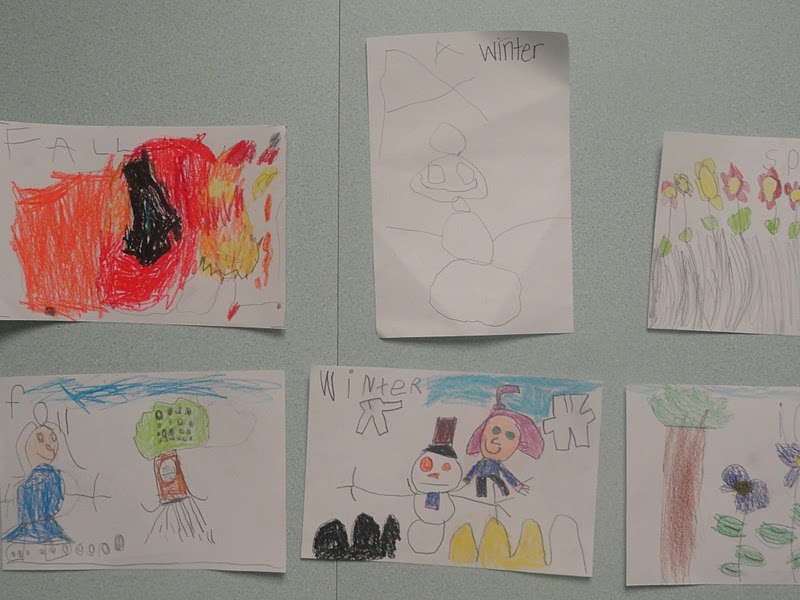
1. The seasons make a pattern: fall, winter, spring, summer.
Each kiddo selects a season and draws a picture. Then, we take all of our pictures and create a pattern of the seasons.


2. Comparing summer and fall.
Below is a chart the class and I made together. Sometimes, I do a venn diagram instead.

We made summer trees with lots of green leaves. The children had to unscramble the letters in the word summer and place the letters side by side to make a word.
This was 2 lessons:
1. what a summer tree looks like
2. a word is a group of letters with no spaces between them.

4. The children wrote a goodbye to summer listing the activity they had the most fun doing.
We brainstormed tons of summertime activities before beginning the writing activity below. The children had to share what they were going to write with a partner in a think-pair-share before beginning. Then, the children had to prewrite by drawing an illustration of the activity in full color. Finally, the children had to sound out their words and try to record a beginning and ending sound for each word in the sentence.


I will post the fall equivalent soon... Hello, Fall! I will have fun__.
- different activities
- kind of clothing worn
- how the weather should change
- & other characteristics the children may not have already known.

Click directly on the book to take you to its amazon page.
Here are documents I used for my lessons:
Goodbye, Summer! Hello, Fall! ... for some reason google docs is not recreating the document exactly right. There should be no space after the "I will have fun" on the second section. If you know what I am doing incorrectly, please let me know.
Summer Word for Summer Tree... Not saving as a PDF. How can I do this? It is changing all my fonts. Think that might be my orginal problem as well.
Fall Word for Fall Tree
Wednesday, September 21, 2011
Owl Babies by Martin Waddell
Ahhhh, Fall.
The weather is perfect and the world is full of all my favorite colors. What could be better?
Well, the perfect read aloud, of course.
 Owl Babies by: Martin Waddell is the perfect book for going over parts of a story. I draw a four square on chart paper. We flip through the story and make predictions on the characters, setting, problem, and solution.
In the first box, I draw a simple smiley face. This is where we list the characters.
In the second box, I draw a tree and house. Here we write all the places we noticed the characters where from our preview.
In the third box, I draw a broken heart. This is where we record the problem.
The last box has a heart drawn in the corner for solution. We write about how we think the problem will be solved by the characters in the story.
At this point, I ask if there are any questions about the story. I will remind the children of their questions as we are reading.
I read the story through. After the story, we go back to our chart and make changes as needed. We cross through incorrect information and add in the information we have learned. We talk about how important it is to make predictions about what we are going to read in order to focus our thinking about the story.
Additional Activities:
The weather is perfect and the world is full of all my favorite colors. What could be better?
Well, the perfect read aloud, of course.
In the first box, I draw a simple smiley face. This is where we list the characters.
In the second box, I draw a tree and house. Here we write all the places we noticed the characters where from our preview.
In the third box, I draw a broken heart. This is where we record the problem.
The last box has a heart drawn in the corner for solution. We write about how we think the problem will be solved by the characters in the story.
At this point, I ask if there are any questions about the story. I will remind the children of their questions as we are reading.
I read the story through. After the story, we go back to our chart and make changes as needed. We cross through incorrect information and add in the information we have learned. We talk about how important it is to make predictions about what we are going to read in order to focus our thinking about the story.
Additional Activities:
- create your favorite character
- create a web about each of the owl babies
- use the webs to discuss the similarities and differences between the characters
- stop before the end of the story and make predictions... use construction paper to make a collage of the prediction
- draw a picture of your favorite part
- draw your favorite character in your journal and write a sentence about why you like that character
- text-to-text connection... think about a time you were scared like Bill... think about a time your mom or dad left you at home and went somewhere else.
Sunday, September 18, 2011
3D Shapes
Teaching 3D shapes in kindergarten is always a challenge for me. We begin my creating a picture dictionary.


At the end of the week, we go on a shape walk to locate 3D shapes in our environment. This time I will point out that most of the shapes we see are 3D shapes, but they have similarities to the 2D counterpart.
I give the children a table with the 3D shapes on it and a place to write the name for each shape. The children are responsible for copying environmental print in order to fill in their own dictionaries.
During the unit, we play several games. Below you will find some of our favorites:
- Can You Guess My Name: Say a riddle such as... I have a curved side. Let the kids guess. I look like a ball. What am I? a sphere. Show the shape. Always start with the vaguest clue and get more specific as you give more clues.
- Find a __: say the name of a 3D shape. Have the children travel around the room to locate the specified shape and point to it. Continue until interest wanes.
At the end of the week, we go on a shape walk to locate 3D shapes in our environment. This time I will point out that most of the shapes we see are 3D shapes, but they have similarities to the 2D counterpart.
During this walk, the children sketch drawings of their objects in a math journal. When we return to the classroom, the drawings will be outlined in black felt pen and colored. Once the drawings are complete the children will label each drawing using a pencil.
The Shape Walk
Shapes are all around us. We see shapes everywhere we go. To teach shapes to little ones, you only have to go as far as the outdoors.
The Shape Walk
With so much time spent using electronics and indoors nowadays, getting the kiddos outside as much as possibly is a high priority for me. So, we begin our unit with a shape walk.
Before going outside, I show pictures of the shapes we will be looking for... circle, oval, triangle, square, and rectangle. Then, we head outdoors.
As we take our walk, I allow the children to take turns snapping pictures of the various shapes we encounter. At a later time, these pictures can be used to create a photo story.
When the children locate shapes, I make sure they are using the appropriate vocabulary to identify it. If not, I provide gentle reminders as needed.
When we return to the classroom, each child receives a 4 X 4 piece of white and draws his/her favorite shape from our walk. We then use the pictures to graph the shapes.
The Shape Walk
With so much time spent using electronics and indoors nowadays, getting the kiddos outside as much as possibly is a high priority for me. So, we begin our unit with a shape walk.
Before going outside, I show pictures of the shapes we will be looking for... circle, oval, triangle, square, and rectangle. Then, we head outdoors.
As we take our walk, I allow the children to take turns snapping pictures of the various shapes we encounter. At a later time, these pictures can be used to create a photo story.
When the children locate shapes, I make sure they are using the appropriate vocabulary to identify it. If not, I provide gentle reminders as needed.
When we return to the classroom, each child receives a 4 X 4 piece of white and draws his/her favorite shape from our walk. We then use the pictures to graph the shapes.
Subscribe to:
Posts (Atom)